
AC Water Leakage: Why It Drips and How to Stop It for Good
A dripping indoor unit is rarely a refrigeration fault. It is a drainage problem nine times out of ten — and the fix is usually faster and cheaper than people expect.
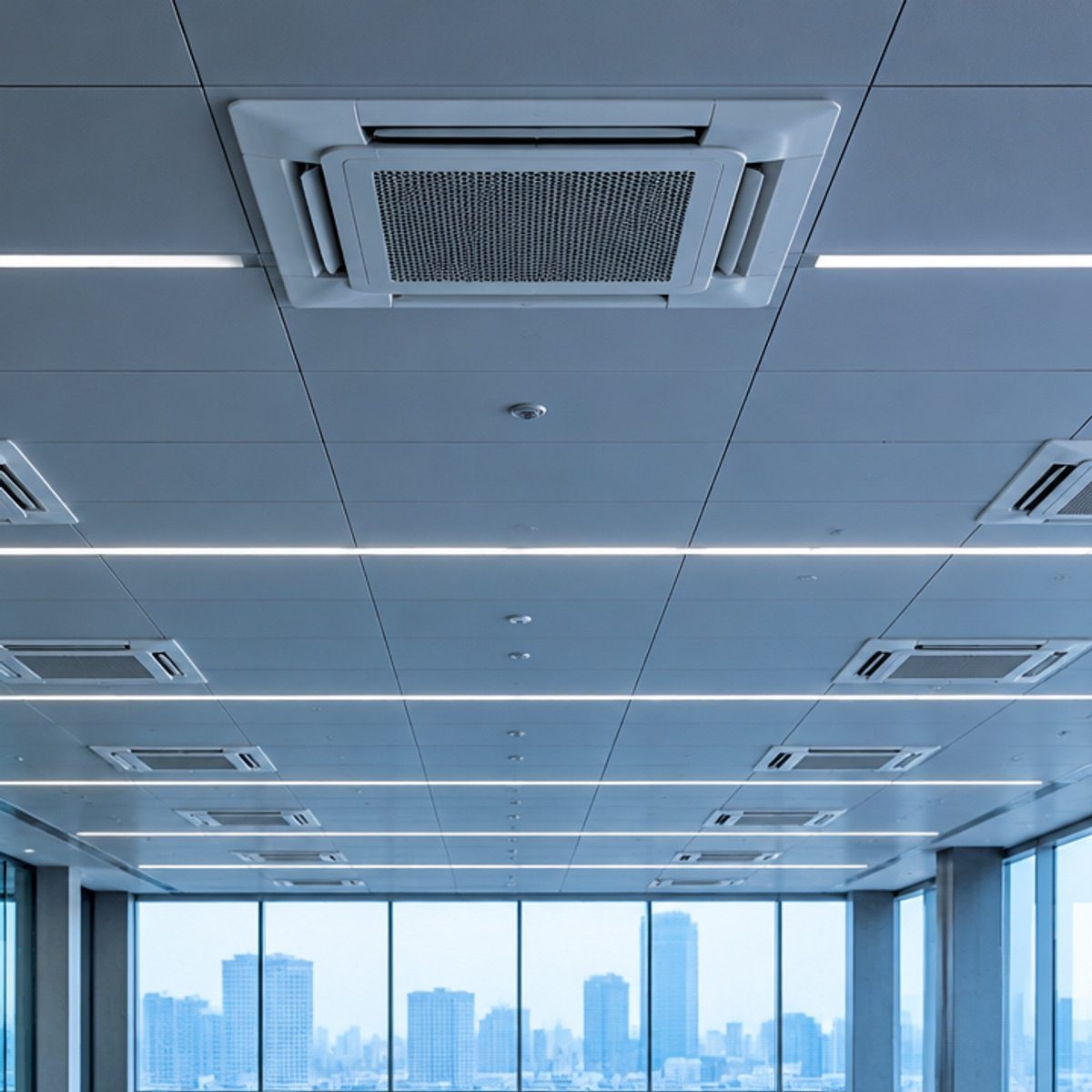
Water on the floor under an indoor unit is the most common service call we receive between June and September, when humidity in the Mumbai metropolitan region sits above 80 percent for weeks. The good news: the cooling circuit is usually fine. Almost every case is one of six drainage and airflow problems, and all six are diagnosable in a single visit.
Where the water is supposed to go
Condensate forms on the evaporator coil whenever warm humid air passes over it. That water falls into a shallow drain tray under the coil, runs to the lower end of the tray, and leaves through a small drain pipe that usually exits with the refrigerant lines and drips outside.
The system only works while three things hold true: the tray is intact, the tray is level or tilted the right way, and the pipe is clear. Any one of them failing sends water somewhere it should not go — into the wall, along the ceiling, or straight down onto the floor.
Understanding that chain makes diagnosis logical instead of guesswork. Each of the six causes below breaks exactly one link.
Cause 1: a blocked drain pipe
This is the single most common cause, by a wide margin. Dust, mould and insect debris accumulate inside the narrow drain hose until flow stops. Water backs up into the tray and then overflows.
The tell-tale is timing: the unit runs dry for twenty to forty minutes, then starts dripping steadily. The longer it runs, the worse it gets.
The fix. The drain pipe is disconnected at the indoor unit, cleared with a flexible wire or low-pressure water, and flushed until it runs freely. A technician should also check the outdoor drip point — if it exits into a wall cavity or a neighbour's balcony, that is a second problem waiting to happen.
Cause 2: ice on the coil, melting later
If the indoor coil freezes, the ice melts after the compressor stops and produces a sudden, heavy drip that has nothing to do with the drain. Ice forms from restricted airflow (dirty filters, blocked coil) or from low refrigerant charge.
The distinguishing feature: airflow feels weak, the louver may show frost, and the dripping starts shortly after the unit switches off rather than while it runs.
The fix. Thaw the unit completely, clean the filters and coil, verify airflow, then pressure test. If charge is low, the leak has to be found — otherwise the ice returns. Cleaning alone will not solve a low-charge freeze.
Cause 3: a tray that no longer drains
The drain tray sits at a slight angle so water flows to the outlet. Over years, dust and biofilm build up in the tray and can block the outlet path even when the pipe itself is clear. A tray that has shifted during cleaning, or a unit that was installed marginally off-level, produces the same effect.
The fix. The tray is cleaned, the outlet is checked, and the indoor unit's level is verified with a spirit level. On cassette units, the built-in drain pump must also be checked — a failed pump overflows the tray even on a perfectly clean system.
Cause 4: insulation damage on the cold pipe
The thin copper line between indoor and outdoor units carries cold refrigerant. It is wrapped in foam insulation. If that insulation splits, cracks or is missing at a joint, humid air condenses directly on bare copper and drips along the pipe route — often several feet from the indoor unit.
The fix. Re-insulate the affected run, seal the joint with tape, and check where the pipe passes through the wall. Water tracking inside the wall is the scenario that damages paintwork and, in bad cases, a neighbour's ceiling.
Causes 5 and 6: installation faults and blockages further out
Installation faults. A drain line that runs uphill anywhere along its length will hold water and overflow. So will one that discharges into a sealed container, or one pinched behind the indoor unit during fitting. These show up soon after installation, which is why a test run with water poured into the tray belongs in every handover.
Blockages further out. On buildings where multiple units share a common drain riser, a blockage two floors up can back water into your unit. If your AC drips only when neighbours run theirs, this is likely, and the fix sits outside your flat.
In every case: switch the unit off, put a bucket under the drip, and do not run it again until the drain is cleared. Water and electrical components share that housing. A ₹549 drain-and-service visit is much cheaper than a PCB replacement.
Key takeaways
- Dripping after 20–40 minutes of running points to a blocked drain pipe.
- Dripping after the unit stops usually means the coil was frozen.
- Water far from the unit is often damaged pipe insulation.
- Cassette units have a drain pump that can fail independently.
- Switch off and dry the area — water near electrics is a real hazard.
Frequently asked questions
Why does my AC drip only at night?
Night-time humidity is higher and outdoor temperatures are lower, so the coil runs colder and condenses more. A marginal drain then overflows only during those hours.
Can I clear the AC drain pipe myself?
The indoor end can sometimes be cleared with a wire, but the pipe is usually inside a wall or conduit. A technician can clear and flush it in one visit for the price of a service.
Is water dripping from an AC dangerous?
The water itself is not hazardous, but it can reach electrical terminals and the PCB. Switch the unit off at the isolator until it is repaired.
Transparent pricing
Featured AC services and rates
Published rates straight from the AK Aircon Services rate card — 13 categories covering service, installation, gas charging, repair, parts and material.
| Service | Split AC | Window AC |
|---|---|---|
| Dry / Lite service | ₹399 | ₹399 |
| Standard jet service | ₹549 | ₹549 |
| Foam jet service | ₹649 | ₹649 |
| Deep dismantle service | ₹1,349 | — |
| Inspection / diagnosis visit | ₹299 | — |
| Gas charging | ₹2,499 | — |
| Leakage repair | ₹1,499 | — |
| Standard installation | ₹1,499 | ₹1,499 |
| Uninstallation | ₹899 | ₹899 |
| Indoor unit shifting | ₹1,299 | — |
| PCB / electrical repair | ₹1,799 | — |
| Compressor replacement | ₹6,499 | — |
| Copper pipe (per metre) | ₹550 | ₹550 |
Prices include labour and material unless a note states otherwise. Installation material is extra. Units above 2.2 tons are quoted individually.
Need a specific price?
Tell us the unit type and the service. We confirm the exact charge before work starts.
See all 13 categoriesRates are transcribed from the AK Aircon Services rate card. Charges for unusual site conditions or non-standard equipment are confirmed before work begins.